
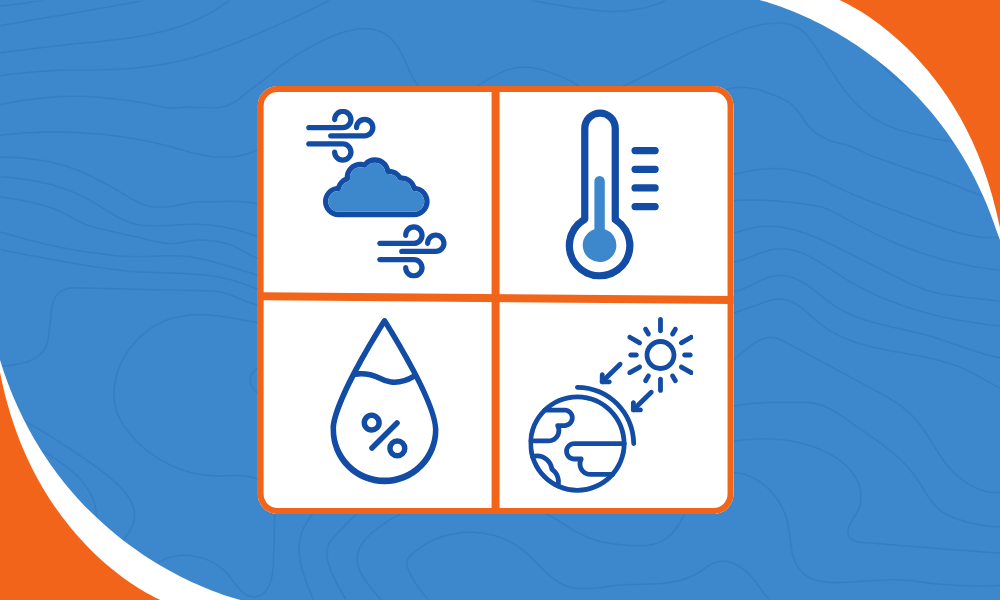
When summer heat becomes dangerous, temperature alone doesn’t tell the whole story. A 92-degree afternoon in dry air feels very different from 92 degrees with high humidity, full sun, and little wind.
The heat index accounts for temperature and relative humidity, but it also assumes you are standing in the shade with a light breeze. That is not necessarily the environment an athlete, outdoor worker, or recruit is actually experiencing.
Wet Bulb Globe Temperature takes a different approach. It accounts for air temperature, humidity, radiant heat, and wind to provide a more complete measure of the heat stress on a person in a particular environment.
How Is Wet Bulb Globe Temperature Calculated?
For outdoor conditions, Wet Bulb Globe Temperature is calculated using three measured temperatures:
WBGT = 0.7 Tnwb + 0.2 Tg + 0.1 Ta
Here, Tnwb is the natural wet bulb temperature, Tg is the globe temperature, and Ta is the actual air temperature.
That may look like only three variables, but each temperature captures something different about the environment.
The natural wet bulb temperature represents the cooling effect of evaporation. The globe temperature captures radiant heat, including heat from the sun. The air temperature provides the ambient temperature.
Together, they account for four important factors: temperature, humidity, solar radiation, and wind.
The weighting is significant. The natural wet bulb temperature gets 70 percent of the calculation, while the globe temperature gets 20 percent and the air temperature gets just 10 percent.
Why does humidity get so much weight? Because sweating is one of the body’s primary ways of getting rid of heat.
Evaporative Cooling Does the Work
Once the air is warmer than your skin, convection starts delivering heat to your body instead of carrying it away. Sweating becomes increasingly important.
Evaporation cools you because it takes energy to turn liquid water into vapor. That energy comes from your skin. The problem is that the water vapor has to go somewhere.
How quickly sweat evaporates depends on the difference between the vapor pressure at your wet skin and the vapor pressure of the surrounding air. Dry air pulls moisture away quickly. Humid air does not.
If the dew point is high enough, that difference becomes small. You can sweat heavily without losing much heat through evaporation. You mostly get wet and dehydrated.
Wind matters for the same reason. Moving air clears away the saturated layer sitting against your skin and replaces it with air that can accept more moisture. In still air, that layer builds up and evaporation slows down.
A wet bulb thermometer works on the same basic principle. It has a wet wick around the sensor and cools itself through evaporation. The temperature it settles at reflects how easily water can evaporate into the surrounding air.
A natural wet bulb thermometer differs from the aspirated wet bulb used in a traditional psychrometer. The natural wet bulb is exposed to the surrounding environment, including the wind and solar radiation that a person outdoors would actually experience.
Measuring Wet Bulb Globe Temperature
Humidity is only part of the picture. Solar radiation can make an enormous difference in how hot an environment feels.
This is where the globe thermometer comes in.
A thermometer sits inside a hollow, matte black copper sphere. The black surface absorbs radiation from the sun and surrounding environment, while air moving across the sphere carries heat away.
The temperature inside the globe eventually settles at a value determined by that balance between heating and cooling.
Put the globe in direct sun, and it heats up. Put it in the shade, and it moves closer to the surrounding air temperature. Increase the wind, and the globe loses heat more quickly.
That makes the globe temperature useful for representing the radiant heat load on an object sitting in the environment.
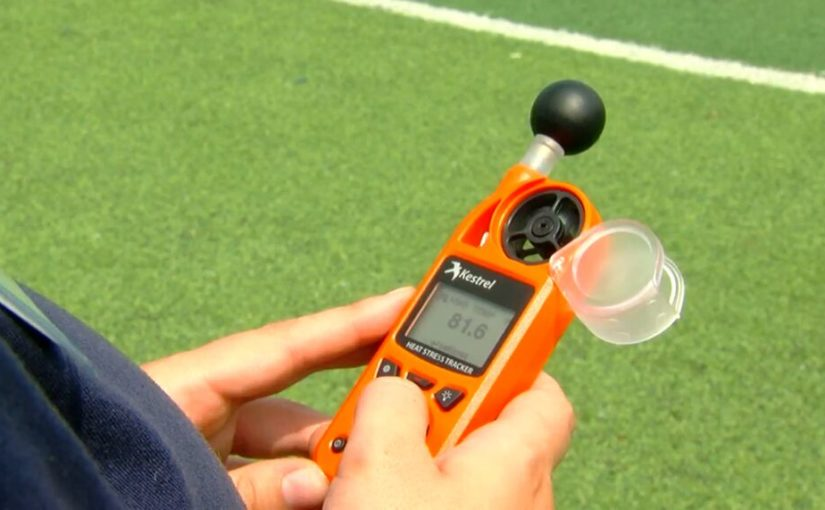
Handheld WBGT thermometer, the Kestrel 5400 Heat Stress Tracker
A separate temperature sensor measures the actual air temperature. The combination of these measurements gives Wet Bulb Globe Temperature the ability to describe the environment more realistically than air temperature alone.
Where Did WBGT Come From?
Wet Bulb Globe Temperature has its roots in the Marine Corps training grounds of Parris Island, South Carolina.
Summer training there could be brutal. High temperatures, high humidity, and strenuous exercise contributed to a significant number of heat casualties among recruits. Army and Navy researchers began looking for a better way to measure the environmental conditions putting people at risk.
The result was an early version of the wet bulb globe thermometer and the heat-stress index we now know as WBGT. Yaglou and Minard developed the index in the 1950s, incorporating measurements of humidity, radiant heat, and air temperature rather than relying on temperature and humidity alone.
The Marine Corps began using WBGT to determine when training conditions became too hazardous. The concept eventually spread well beyond the military and is now used in workplaces, athletics, and other situations where people are exposed to heat.
Why Does Siting Matter for Wet Bulb Globe Temperature?
A WBGT measurement is only useful if it represents the environment you are trying to understand.
This is similar to the importance of proper weather station siting. A globe sitting in the shade will experience a different environment than one sitting over a sunny field.
For example, an athlete practicing on artificial turf is experiencing a different radiant and surface heat environment than someone standing under a nearby tree.
If the goal is to determine whether conditions are appropriate for athletes, the measurement should represent the environment where those athletes actually are.
That makes siting just as important as the calculation itself.
Turning WBGT Into Something Useful
Wet Bulb Globe Temperature doesn’t have to reach the end user as a number. The underlying measurements can be incorporated into an application that turns complex environmental conditions into information people can actually use.
One example is the golf playability index developed by Flash Weather. The index uses Flash Weather’s formula together with weather data from Wet Dog Weather to calculate a percentage representing golf playability under current conditions.
In this example, Wet Bulb Globe Temperature is one factor contributing to the overall index. Instead of asking a golfer to look at a WBGT value and determine what it means for their round, the application combines the relevant weather conditions and presents the result in a more accessible format.
Wet Dog Weather’s Terrier displays the data and the resulting index, bringing the weather information and visualization together in one application.
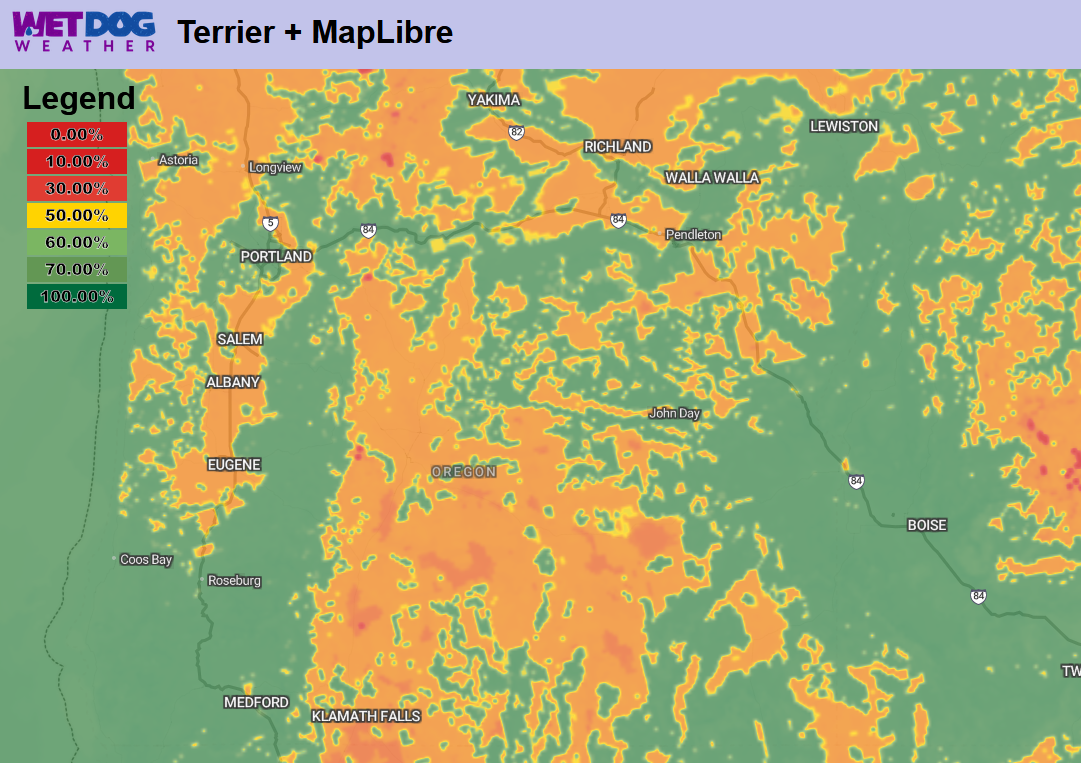
Flash Weather’s golf playability index, calculated using its formula and Wet Dog Weather data and displayed with Terrier.
This is one advantage of weather data: the underlying measurements can be complicated, but the information delivered to the end user does not have to be.
Looking Beyond the Thermometer
Air temperature alone doesn’t determine heat stress. Humidity affects evaporation, wind changes how quickly heat and moisture move away from the body, and solar radiation can significantly increase a person’s outdoor heat load.
Wet Bulb Globe Temperature combines those factors into a measurement designed to represent heat stress in a real environment.
For organizations making decisions about outdoor work, athletics, training, or other heat-sensitive activities, that additional context can be more useful than temperature alone. When WBGT is combined with other weather data and built into an application, it can become more than a measurement. It can become a tool for turning complex environmental conditions into information people can actually use.