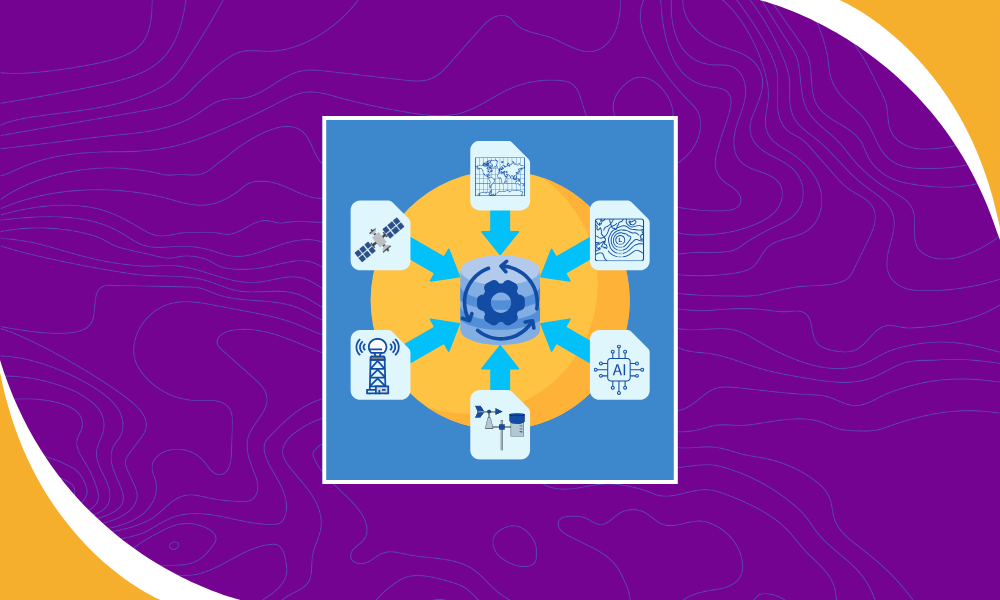
Weather data used to come from a relatively familiar list of sources: weather stations, radar, satellites, and numerical weather models. Today, that list is getting much longer. There are more sensors, observation networks, high-resolution models, machine learning forecasts, satellite products, connected devices, and specialized datasets than ever before.
For people building weather applications, that’s exciting. More weather data sources mean more opportunities to understand what is happening in the atmosphere. But they also introduce a new challenge. The more sources there are, the harder it becomes to bring them together and turn all that information into something an application can actually use.
The Growing Number of Weather Data Sources
Traditional observations are still the foundation of modern weather information. Surface stations measure temperature, pressure, wind, humidity, and precipitation. Radar shows where precipitation is falling and how it is moving. Satellites provide observations across vast areas, while numerical weather models forecast future atmospheric conditions.
Those familiar weather data sources are now being joined by an expanding collection of additional observations and specialized datasets. Private sensor networks, drones, lidar, crowdsourced observations, and machine learning models are adding new ways to observe and understand the atmosphere.
This doesn’t mean the traditional sources are becoming less important. Instead, the weather data ecosystem is becoming more diverse. Each source provides a different piece of information, and combining them can create a more complete picture of current and future conditions.
Understanding the Differences Between Data Sources
Every data source has its own characteristics, and those differences matter when you combine datasets. Weather data sources can differ in spatial and temporal resolution, geographic coverage, update frequency, format, units, and quality-control processes. Even two datasets describing the same variable may not agree perfectly.
That’s not necessarily a problem. Weather observations measure a constantly changing atmosphere, and every observing system has limitations. The important thing is understanding those limitations and handling the data appropriately.
This becomes especially important when an application combines several weather data sources. Developers need to understand what each dataset represents, when it was produced, how it was processed, and how it relates to the other information being displayed. The more information an application brings together, the more important that context becomes.
The Hard Part Is Making It All Work Together
Imagine an application that needs current radar, surface observations, a numerical weather model, and a specialized forecast. Each dataset might come from a different provider and use a different format, grid, projection, timestamp, or naming convention. One source might update every few minutes while another updates only a few times a day.
Before an application can use those datasets together, the data may need to be ingested, transformed, regridded, quality-controlled, organized, and made available through an interface the application can actually use. The behind-the-scenes work makes it possible for those different sources to appear together as a coherent product.
This is one reason the infrastructure behind weather data matters. At Wet Dog Weather, our Boxer Cloud-native weather data processing system is built to handle different types of weather data, including weather models, proprietary datasets, and custom data. The goal isn’t to make every dataset identical. It’s to provide the processing and infrastructure needed to turn those datasets into something applications can use.
AI Adds Another Layer
Artificial intelligence and machine learning are adding another dimension to the growing weather data ecosystem. AI models can use observations and model output to generate new forecasts, identify patterns, downscale information, or produce specialized products. As these technologies become more common, they are creating another category of data that applications may want to incorporate.
But AI doesn’t eliminate the need for good underlying data. It makes the quality, consistency, and accessibility of that data even more important. A model still needs inputs; those inputs still need to be understood and processed, and the resulting output still needs to make its way into an application where someone can actually use it.
In some cases, AI can also complicate the data ecosystem. A new model may depend on several existing datasets, and its output can become another potential input for an application. Instead of replacing existing weather data sources, AI adds another layer to the overall system.
The Future Isn’t One Weather Data Source
It’s tempting to think that eventually one model, one observation network, or one technology will provide everything an application needs. Instead, the weather data ecosystem seems to be moving in the opposite direction. We’re seeing more specialization and more sources working together.
A modern weather application might combine observations with radar, satellite data, numerical models, machine learning output, private sensors, and other specialized datasets. Each can provide a different piece of the picture, and the application can use those pieces to create something much more useful than any individual dataset could provide on its own.
As the number and variety of weather data sources grow, the infrastructure connecting them becomes increasingly important. Weather data can come from almost anywhere. The real opportunity is bringing it together, transforming it, and delivering it in a way that makes it useful for the applications built on top of it.