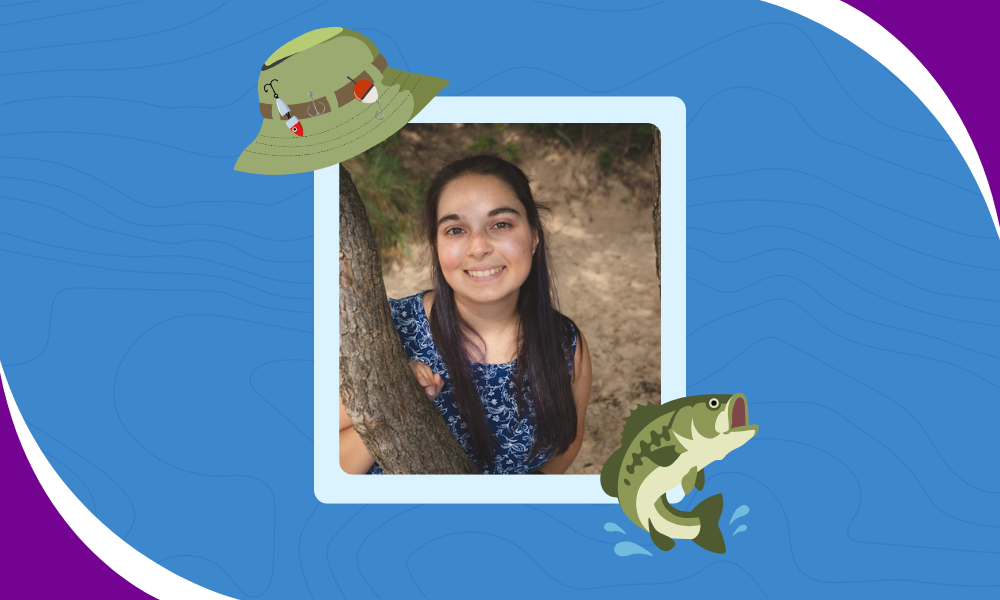
When most people check the weather before going fishing, they’re looking for a simple forecast. Lex Hudson wanted to go a step further.
The Central Michigan University meteorology student is spending the summer developing FishCast. This AI fishing weather app combines weather data with a Fishing Index to help anglers understand how changing conditions affect fish behavior.
Throughout the summer, Lex has also documented her progress in our AI Journal, sharing the challenges and lessons she has learned while building FishCast with AI and Wet Dog Weather data.
From Meteorology to Software Development
Lex’s interest in meteorology began in high school during an environmental science class, where she learned about the atmosphere and global climate. It quickly became her favorite subject and ultimately led her to pursue a degree in meteorology at Central Michigan University, where she’ll begin her senior year this fall while also participating in the Honors Program.
Although she enjoyed studying meteorology, she wasn’t immediately sure what career path she wanted to follow. That changed after interning at a television station, where she discovered she enjoyed working behind the scenes with the software used to create weather broadcasts even more than presenting forecasts on camera.
That experience sparked a new interest in software development and data analysis, making Wet Dog Weather’s AI internship a perfect fit.
Building FishCast: An AI Fishing Weather App
This summer, Lex has been developing FishCast, an AI fishing weather app designed specifically for anglers across Michigan.
The application combines weather data from Wet Dog Weather with additional data sources to calculate a Fishing Index based on conditions such as atmospheric pressure and water temperature. Rather than simply telling users when fishing conditions are favorable, FishCast helps explain why.
“One of my goals was to help users understand that meteorology is complex,” Lex said.
During her research, Lex found that many fishing apps recommend the best times to fish without explaining the science behind those recommendations. She wanted to build a tool that not only provides useful information but also teaches anglers how weather influences fish behavior.
Her inspiration also came from home.
Growing up, Lex’s father frequently asked her about the weather before heading out on the water and often shared sayings like, “Winds from the east, fish bite the least.” Building FishCast allowed her to investigate the science behind those traditional fishing observations while creating a resource for anglers like her dad.
Turning Ideas into an App
Before this internship, Lex had never built a software application.
Although AI helped her quickly create the visual design of FishCast, she soon realized that building an application involved much more than creating an attractive interface.
“Integrating your data into your platform is an entirely different challenge,” she explained.
Connecting weather datasets, ensuring they updated automatically, and displaying them correctly on an interactive map required much more detailed prompts than designing the application itself. Along the way, she discovered that AI works best when large projects are broken into smaller, well-defined tasks.
Throughout the internship, Lex learned that building an AI fishing weather app requires much more than generating code. Success depends on understanding the data, providing AI with clear instructions, and verifying that everything works as intended.
Learning When to Prioritize
One of Lex’s biggest technical challenges involved displaying radar reflectivity as a weather overlay on the FishCast map.
Although it would have been a useful feature, it wasn’t essential to the Fishing Index or the app’s primary purpose. After spending considerable time trying to solve the problem, she made the difficult decision to move on and focus on higher-priority features.
That experience taught her an important lesson about software development.
With limited time available during the internship, prioritizing the features that deliver the most value became just as important as solving difficult technical problems.
Lessons from Working with AI
Before beginning the internship, Lex expected AI to require extensive corrections before producing useful results.
Instead, she found that its success largely depended on the quality of the instructions she provided.
“I discovered that AI generally produces results that are only as good as the prompts I give it,” she said.
She was especially impressed by AI’s ability to understand visual design requests. While building FishCast, she asked AI to hide smaller lakes until users zoomed in, reducing clutter on the map. AI correctly interpreted the request and implemented the feature without requiring detailed programming instructions.
At the same time, she learned that different AI tools and development environments have different strengths. Some assistants attempted to modify files or add features she hadn’t requested. In contrast, others offered more controlled workflows that better matched her development style.
Despite AI’s rapid progress, Lex believes human expertise remains essential.
“We still need software engineers and computer scientists to fact-check what AI outputs.”
Future Plans
The internship has given Lex valuable experience in software development, weather data analysis, and practical AI applications, reinforcing her interest in pursuing a career that combines those skills.
She’s excited to continue expanding FishCast beyond Michigan’s inland lakes and into the Great Lakes, creating an AI fishing weather app that helps even more anglers understand how changing weather conditions influence fishing success.
As she continues developing FishCast, Lex looks forward to exploring new ways to make complex weather data more accessible through software, research, and AI.
Watch the Final Presentation
Learn why Lex chose to build FishCast, how she researched the relationship between weather and fishing conditions, and how those findings shaped her AI fishing weather app.