
We launched our future radar product a few weeks ago, and it’s going great. The visual side looks good and should serve our customers well. Now we’re digging into the data side, specifically how future radar WCS queries work in practice.
Let’s take a look at how this works behind the scenes and how you can start pulling this data yourself.
Future Radar WCS Queries
Web Coverage Service (WCS) is an OGC standard for querying gridded datasets and works well with weather data, including future radar WCS queries like the ones we’re using here. We’ve been using WCS for a while, have done a fair bit of optimization, and are now comfortably settled on WCS as our main data query method.
The basics are pretty simple. You make queries, you get data back.
Twin Lake Precipitation
For example, here’s a query for the MRMS composite reflectivity right at Twin Lake, Mississippi. Rather than the URL, let’s focus on the arguments.
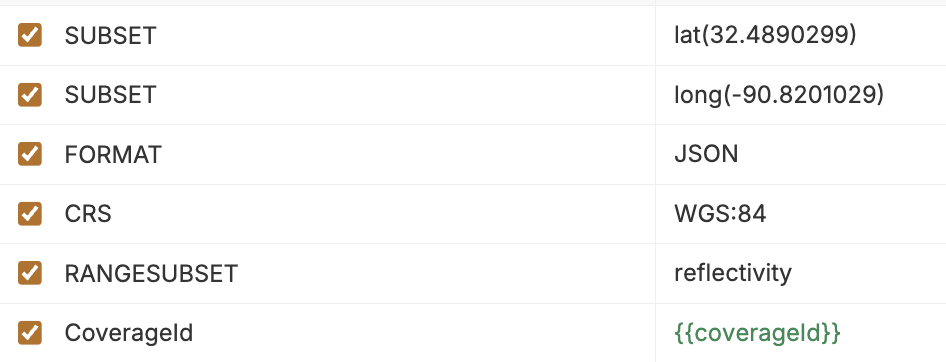
Let’s make that query a bit more obvious visually.
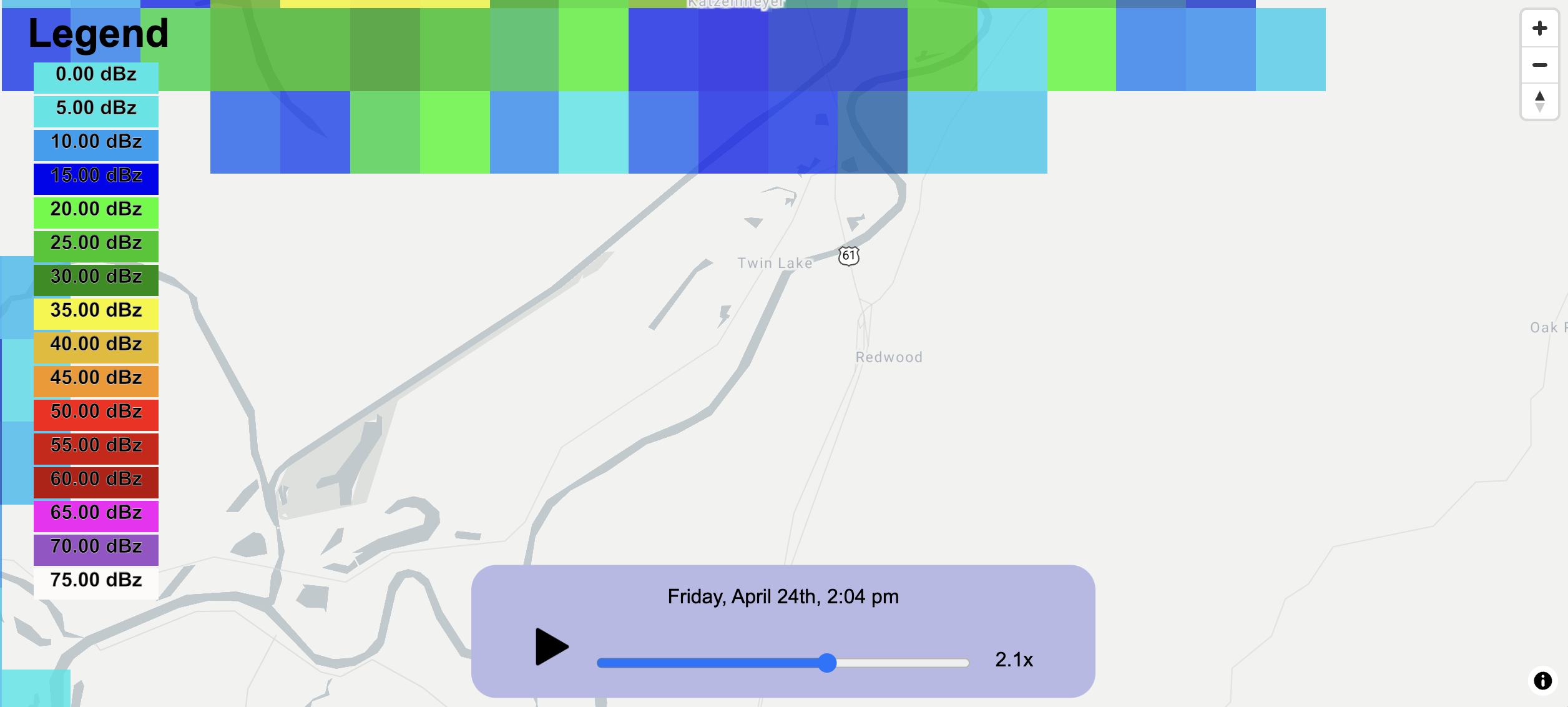
The response is basically what you’d expect. Nothing is going on there.
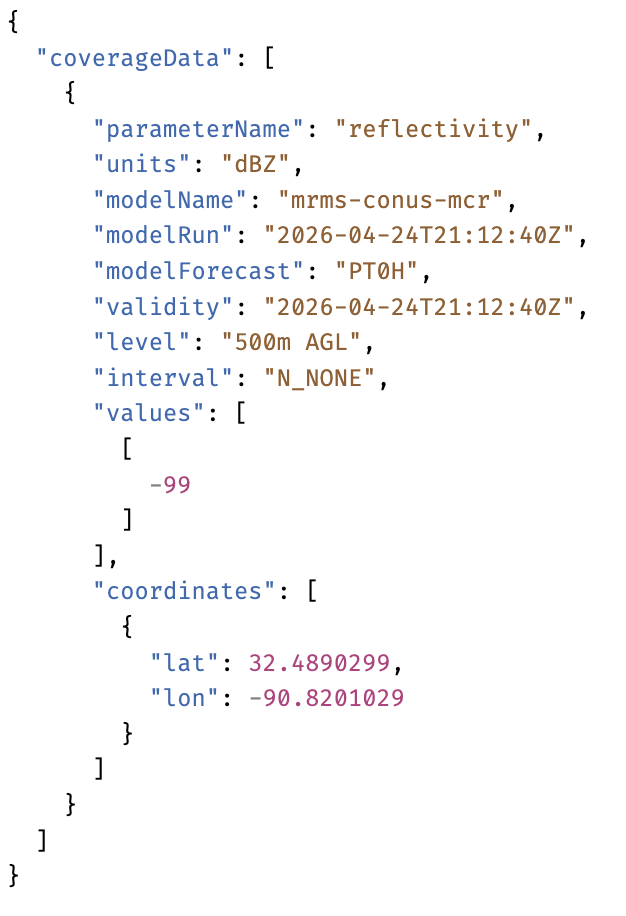
Oh, but there’s about to be! Let’s look ahead a few minutes.
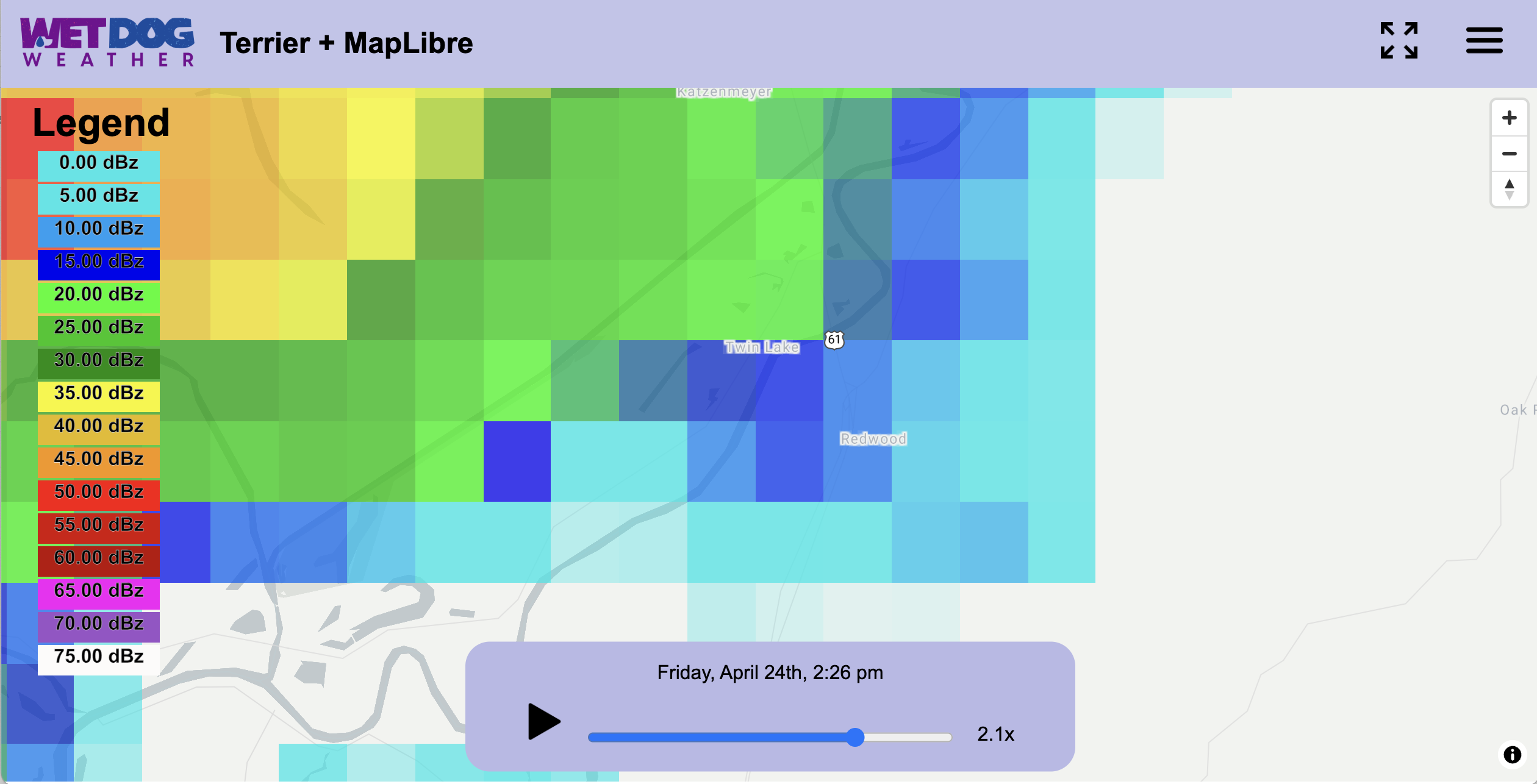
Looking at our future radar, something is about to happen. So when? Let’s ask WCS. Here are the parameters for doing that.
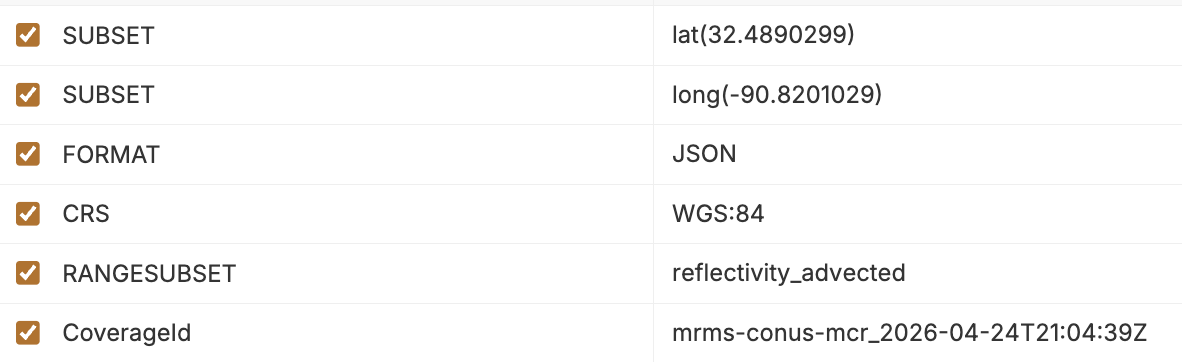
We’re requesting the advected reflectivity dataset from MRMS for composite reflectivity at a specific model run. Essentially, the future radar is the model, and we run it each time we get a new MRMS mosaic input.
Matching that up to the same time, we get:
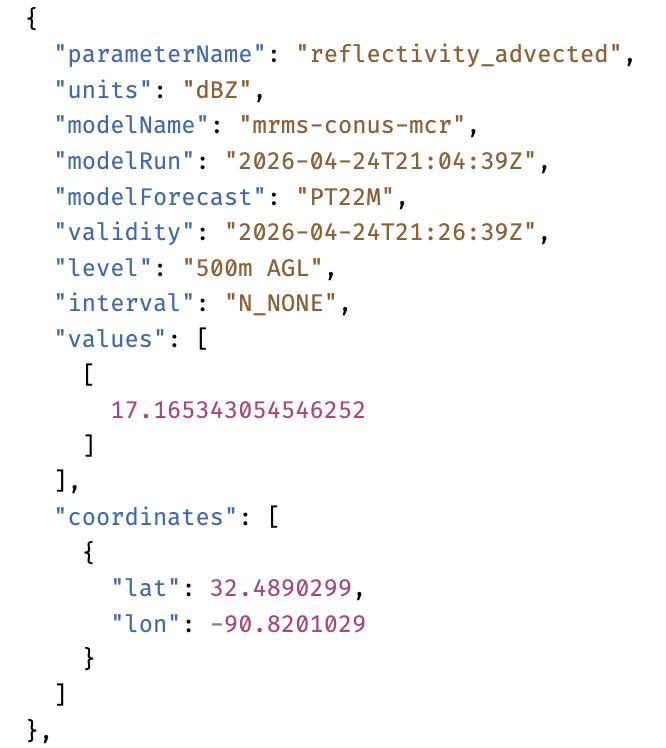
That’s 22 minutes after the start time (modelForecast), and it’s based on data from 21:04. It takes a little while to run the radar advection, so we’ll always lag a bit behind the latest MRMS frame.
We see a reflectivity of 17dbz, which you can convert to rainfall if you’d like. The important bit is it’s probably raining. Or snowing, which you could establish by hitting HRRR with WCS and doing a bit of math. But it’s Mississippi, so we’ll just assume it’s raining.
When Does It Start?
It might be useful to know when that rain is going to start, or as close as we can manage. The reflectivity_advected return gives us some clues. Here’s the first entry with a positive reflectivity.
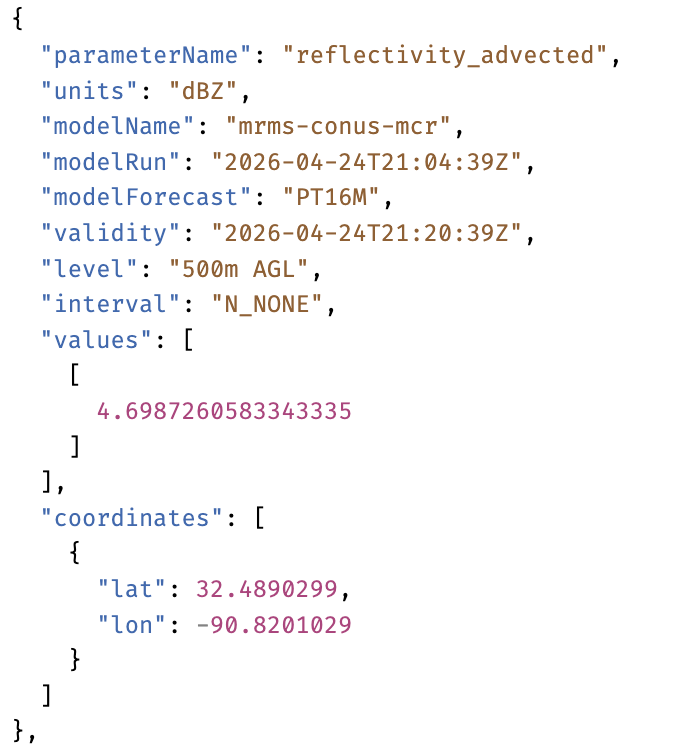
And if we look at the display.
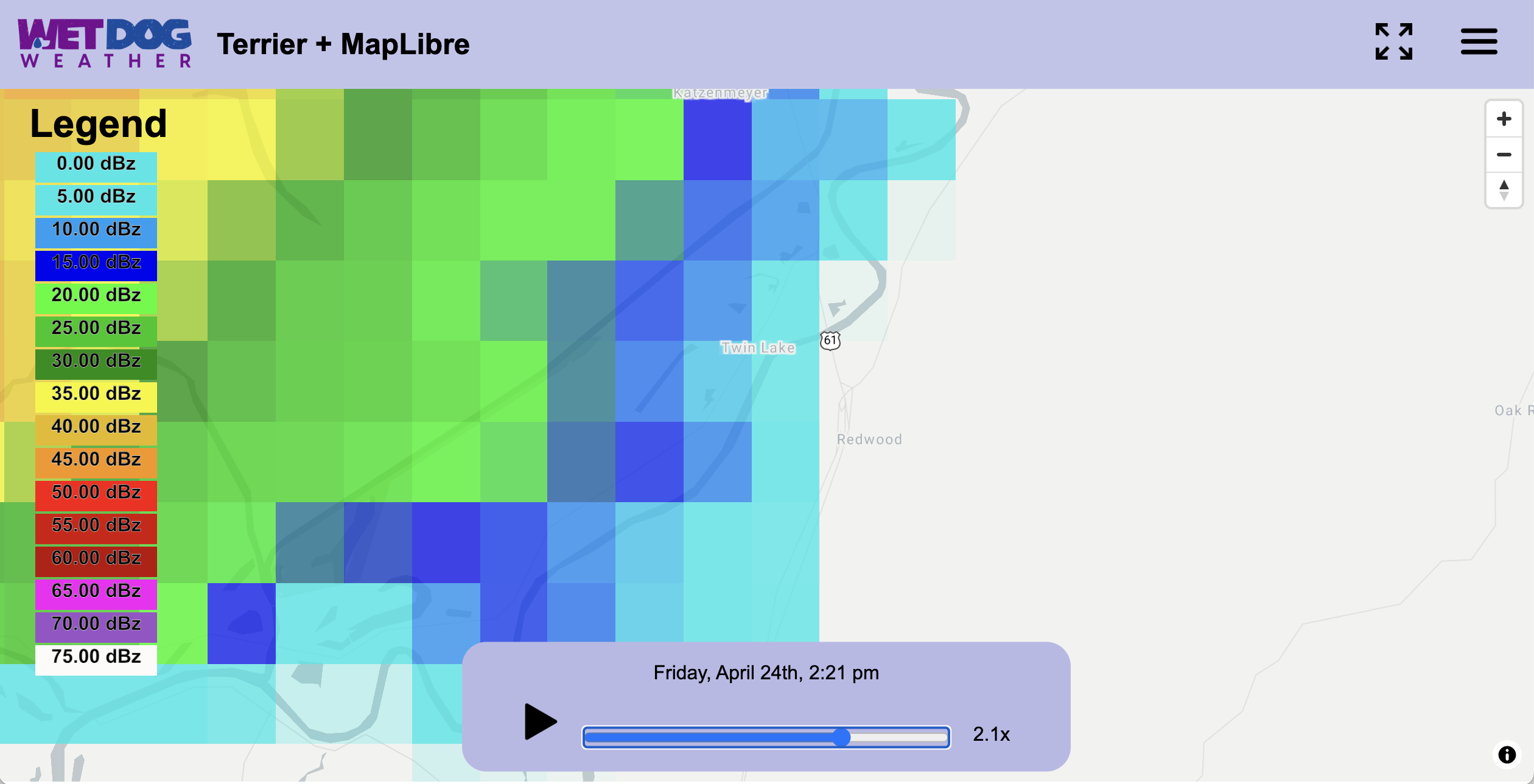
Yup, sure looks like it’s raining in Twin Lake.
Improvements and Availability
As to where we’re going, this sort of thing involves a few extra steps. We have this notion of ‘latest’ in our WCS queries that short-circuits a lot of the rummaging to find the latest complete dataset.
The definition of ‘complete’ gets a little wonky in this case, so you may find a new MRMS frame without the corresponding future radar. It’s likely still running. WCS provides a full catalog of data, so you can figure out where the latest reflectivity_advected is, but it might be nice to make that simpler, like ‘latest’ does for models.
If you have WCS from Wet Dog Weather, this is available now. MRMS is a free dataset, and we’ve rolled our future radar product into it. You can start making future radar WCS queries right now.