
We recently released a future radar product across several North American domains, and it’s already sparked some ideas around real-time precipitation type. The most popular domain is likely to be the continental US (CONUS), but the others have their uses.
Alaska has only a few radar stations, yet it experiences some very dramatic weather at times. We’re running advected radar on this region as often as we do the others, and the results look pretty solid.
Poking around the Alaska radar makes me think about precipitation type, something I’ve always wanted us to take a run at.
Real-Time Precipitation Type
We do something fairly simple to display the likely precipitation type with the radar. Specifically, we’ll grab the temperature at the appropriate time and approximate where we think the snow/rain cutoff is likely to be. You can see that pretty clearly in one of the Alaska timesteps.
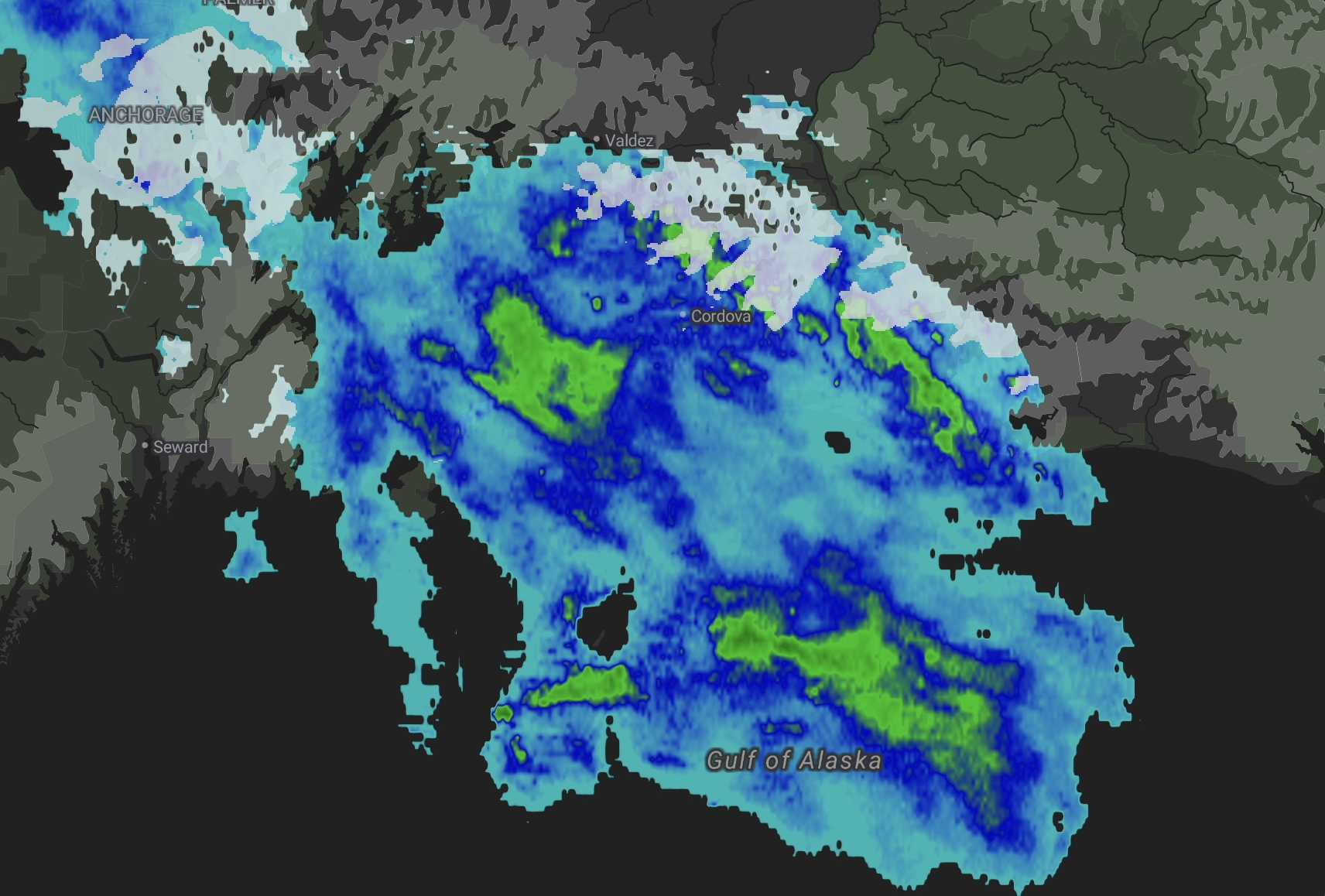
It’s a simple visual trick and not suitable for analysis. I’ve always wanted us to do better with real-time precipitation type.
Models like HRRR and GFS get much more specific with surface precipitation. NDFD can get very specific indeed, my personal favorite being “freezing fog”. But those are models and can’t be updated with real-time data very quickly. When we use them, as we do with HRRR above, we’re behind the real data.
The NEXRAD radars do provide precipitation type, and the MRMS composite does too. That looks pretty good!
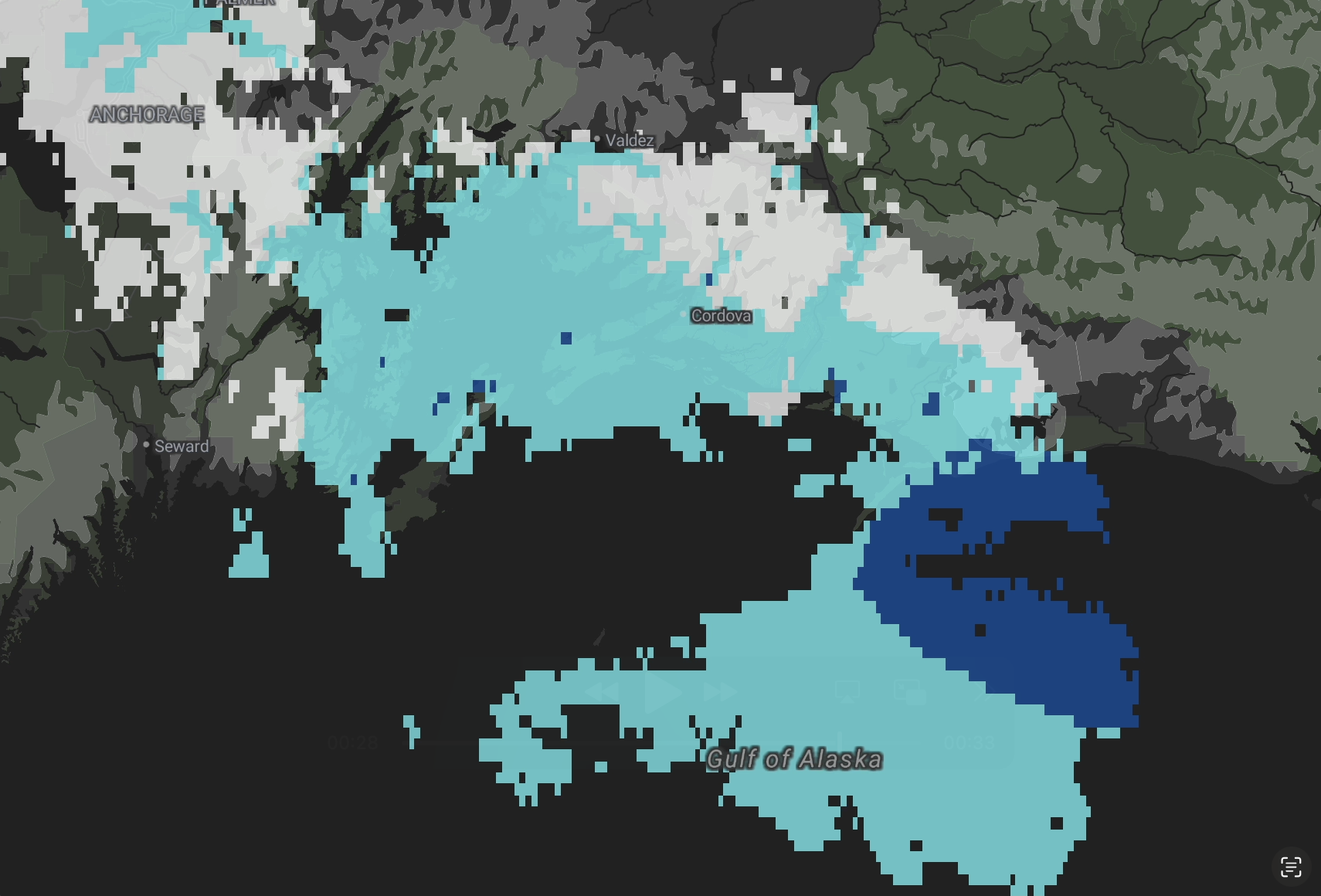
Not a terrible match with the HRRR temperature layer, even. So why not use the MRMS? Well, we do have it as a separate layer, so our customers can display it as needed. In the combo radar layer, it’s missing a bit of what we’d want. Specifically, if the radar doesn’t know the precipitation type, there’s nothing there.
Radars are sensors, so that’s perfectly reasonable, but it leaves big gaps that will confuse users. Not very satisfying, but look at some of those, pretty accurate, precip types like convective precip and hail! Would love to get those blended in.
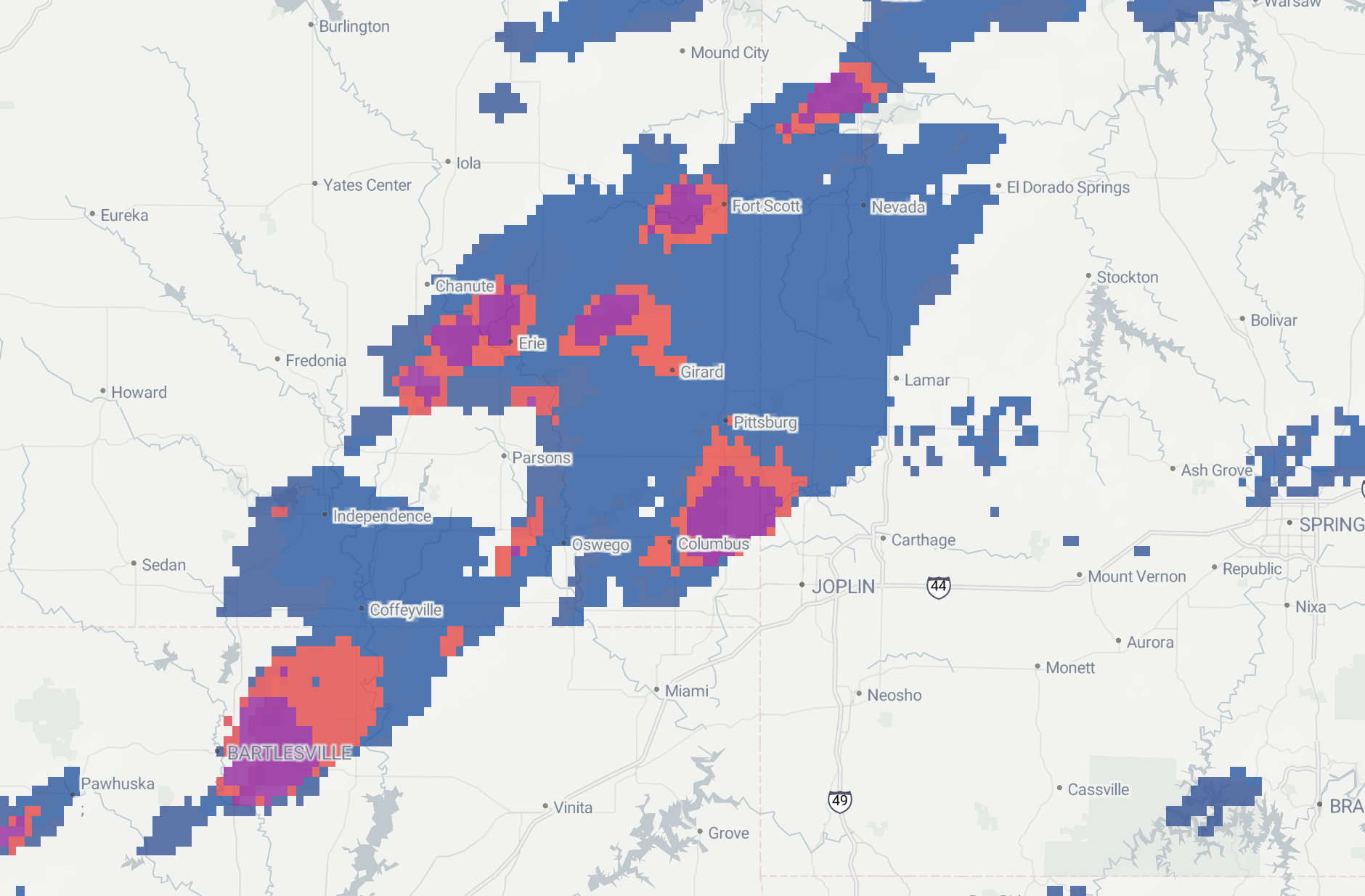
Wouldn’t it be great to get all of that into a more complete real-time precipitation type layer?
A Better Precipitation Layer
We’ve been dreaming of a better precip layer for a while. Models do a pretty decent job beyond the next hour or so. We’d likely pull from NDFD or HRRR, dropping back to GFS elsewhere. One of our partners provides a blended model that might work better globally, at least for the future beyond the next hour.
In the near term, advecting MRMS is fairly obvious. It’s a bit questionable with hail, and we’d probably want to avoid more extreme events. The optical flow algorithm we’re using works reasonably well for reflectivity, but precipitation type can get trickier. Still, it gives us a good starting point for building a stronger real-time precipitation type solution.
Where we’re missing MRMS, we’ll need to make something up from a model and blend it in. We have rich sources in HRRR and NDFD, as well as a partner model that could be interesting.
Looking Ahead
Bringing together radar observations, model guidance, and interpolation techniques into a single, seamless view isn’t trivial, but it’s exactly the kind of challenge we like to take on. A more complete real-time precipitation type layer would give users a clearer, more intuitive understanding of what’s actually happening, without forcing them to interpret multiple datasets at once.
It’s an interesting problem we’d love to look into. Much like future radar, we’re waiting for the right customer to need it. If that’s you, drop us a line!