Winter storms often produce mixed precipitation types rather than sticking to a single form. Some of the most impactful events bring a messy combination of rain, freezing rain, sleet, and snow, sometimes all within a few miles of each other. Understanding how and why that happens starts by looking at what occurs between the surface and the cloud deck.
The Warm Nose
If you’ve read our earlier post on atmospheric sounding interpretation, you’re already familiar with Skew-T diagrams and how temperature changes with height. Mixed precipitation events are where that knowledge really pays off.
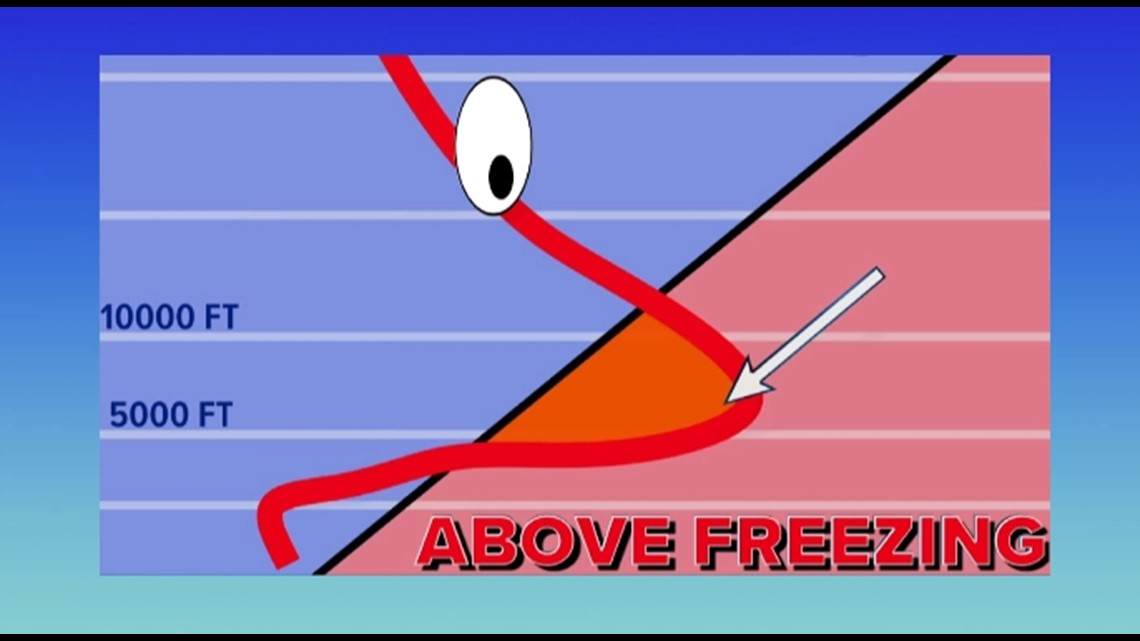
In a simple snowstorm, the entire column stays below freezing from cloud level to the surface. Mixed precipitation types occur when a layer of above-freezing air, typically between 1.5 and 3 km, overlies a cold surface layer. Meteorologists call this a warm nose, as it appears as a “nose” sticking out to the right (warmer) side on a Skew-T.
Four Mixed Precipitation Types, One Storm
The type of precipitation that reaches the ground depends on the temperature profile between the cloud deck and the surface. As snowflakes fall through warm and cold layers, they can melt, refreeze, or remain frozen, producing several mixed precipitation types within the same storm.
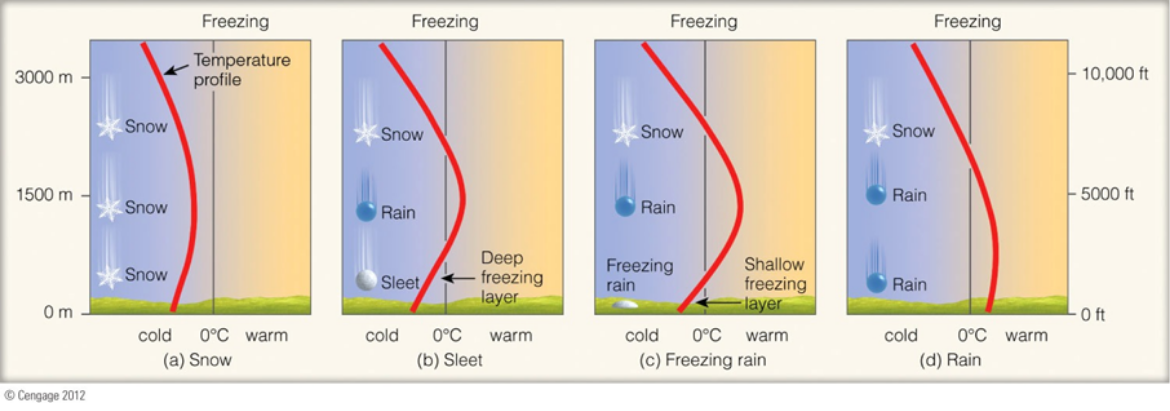
Snow reaches the ground normally when the entire column remains at or below freezing. Nothing melts on the way down.
Sleet forms when snowflakes melt in the warm nose, then refreeze into ice pellets within a sufficiently deep subfreezing layer near the surface.
Freezing rain follows a similar path, but the surface cold layer is too shallow for drops to refreeze in flight. They arrive as supercooled liquid and typically freeze on contact with cold surfaces, such as roads and windshields.
Rain simply means the warm layer extends to the surface.
A Bit of Microphysics
These transitions aren’t always clear-cut. Due to thermodynamics, melting absorbs heat from the warm nose, which can gradually cool it and shift the precipitation type back toward snow during strong events.
Conversely, evaporation in dry, low-level air extracts the heat required for the phase transition (known as evaporative cooling), lowering the temperature near the surface and helping create subfreezing conditions that produce freezing rain or sleet.
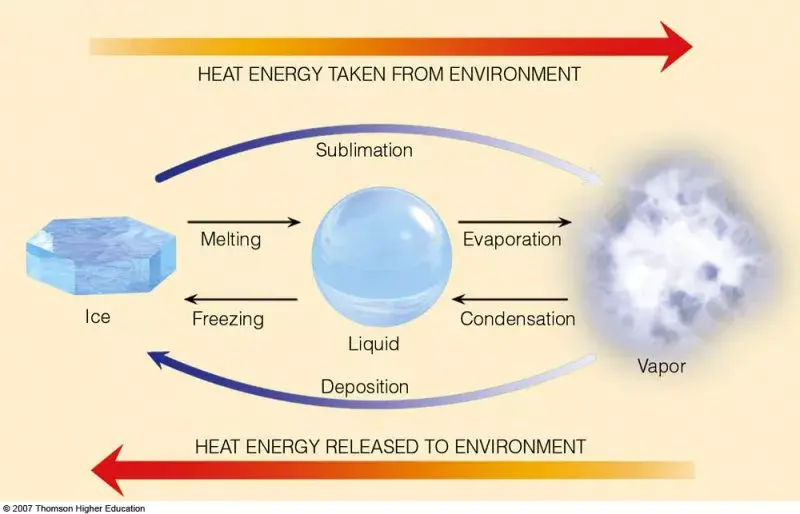
When supercooled drops finally freeze, the latent heat released as the atoms organize from a quasi-chaotic liquid state into a stable solid state actually works against further refreezing. The precipitation is constantly reshaping the very temperature profile that determines its type.
Why it Matters
A shift in the warm nose of just a single degree or a few hundred feet can flip an entire region from sleet to freezing rain, and the impact difference can be huge. Surface temperature alone won’t tell you what to fully expect, but it does provide a good proxy for likely hydrometeor candidates.
The loop above shows mixed precipitation types: rain in green and yellow, freezing mixed precipitation in pink, and snow in blue.
Tools like Terrier, our real-time weather visualization product, help users display precipitation-type data directly in their applications and dashboards.
Understanding Mixed Precipitation Types
Mixed precipitation types are one of the most challenging aspects of winter forecasting because they depend on the exact structure of the atmosphere above the surface. A storm may produce snow in one location, sleet a few miles away, and freezing rain just down the road, all from the same system.
Understanding what happens between the cloud deck and the ground is essential. Surface observations alone rarely capture the full picture. The vertical temperature profile, especially the presence and depth of the warm nose, ultimately determines which precipitation type reaches the surface.
At Wet Dog Weather, we help users visualize where rain, freezing rain, sleet, and snow are most likely to occur so they can better understand and respond to winter weather.