
We have three interns this summer working on AI-generated dashboards using Wet Dog Weather datasets. They’ve been working for three weeks now, and let’s see what they’re up to.
Air Quality AI-Generated Dashboards
We started them out on an air quality dashboard. A single, small project to try out the tools and see what might work for their bigger projects.
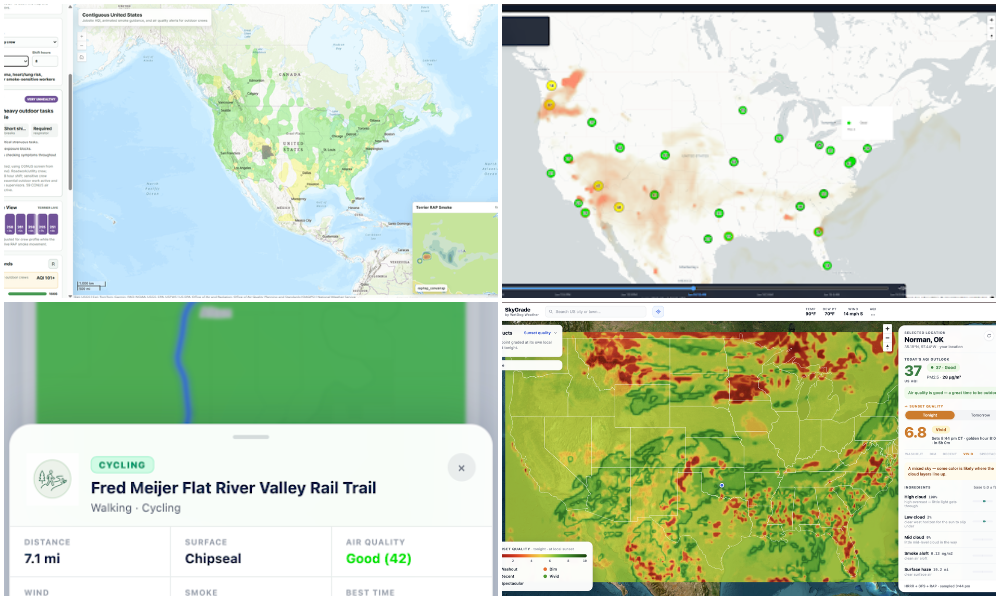
The results looked quite good and were instantly informative.
First Impressions
My first take is that it’s relatively easy to get something up and running. Each of them got a basic site or app up, and it looks like what they intended. If you’d like more details, check out their AI Journals.
LLMs (Large Language Models) are pretty good at making something show up quickly. Each was able to get a display working and add bits and pieces they intended.
Our intern group has varying levels of software engineering skill, more on the Python side of things, and the LLMs helped them build JavaScript-based systems, for the most part. That’s an encouraging result and shows how quickly AI-generated dashboards can come together, even for developers working outside their primary programming language.
That’s pretty good and what we’d hope to see.
Second Impressions
In discussion, it became clear that the LLMs weren’t forthcoming or aware of the data’s source. It wasn’t at all clear what they were querying or even how.
The map parts worked well, but some display layers claimed to be from Terrier, but clearly weren’t. The word “Terrier” was associated with individual point values, even though we hadn’t given them access to those APIs yet. And in any case, they aren’t part of Terrier.
In one case, an LLM completely imagined a dataset. In another, it had clearly offset an image, so it didn’t cover the right geographic area. Those kinds of issues highlight why AI-generated dashboards still require careful review by people who understand the underlying data and technology.
That’s not at all surprising and in line with the general consensus on this technology.
Initial Conclusions on AI-Generated Dashboards
My general conclusion is that expertise becomes even more important when putting this kind of thing together.
Each of our interns has a science background, which gives them the tools to think about the data. They can learn enough about air quality data, how it’s produced, and where it comes from to unravel the mysteries of what the LLM is doing.
The real danger is from someone without that analytic background whipping up something truly random. But honestly, that’s always been a problem. Now it’s just much flashier.
Focusing on us, Wet Dog Weather, I can see we need to be easier for LLMs to consume. There are ways of describing interfaces at a high level and passing back data that LLMs can process more easily.
What’s Next
As the interns move on to their larger summer projects, these first AI-generated dashboards have already taught us an important lesson. AI can accelerate development, but it still takes domain expertise to verify the data, understand the results, and build something people can trust. We’re looking forward to seeing how those lessons shape the next round of dashboards.