Recently, we published a blog post to explain global weather patterns. We covered Eulerian and Lagrangian frames, advection, circulation cells, and the jet stream. Now is the time to unpack arguably the most famous teleconnection of all: the El Niño weather pattern. While it often gets reduced to a buzzword in seasonal forecasts, the science behind it helps explain why weather shifts can ripple far beyond the tropical Pacific.
What ENSO Actually Is
The El Niño weather pattern is one phase of a larger coupled ocean-atmosphere system called ENSO (El Niño-Southern Oscillation). The ocean and atmosphere constantly exchange energy through a feedback loop, and those interactions influence weather patterns around the globe.
At the center of ENSO is a sizeable stretch of the eastern Pacific Ocean where cool water frequently rises to the surface through upwelling. Under normal conditions, trade winds push warm surface water west toward Indonesia, allowing colder, nutrient-rich water to rise near the coast of Peru.
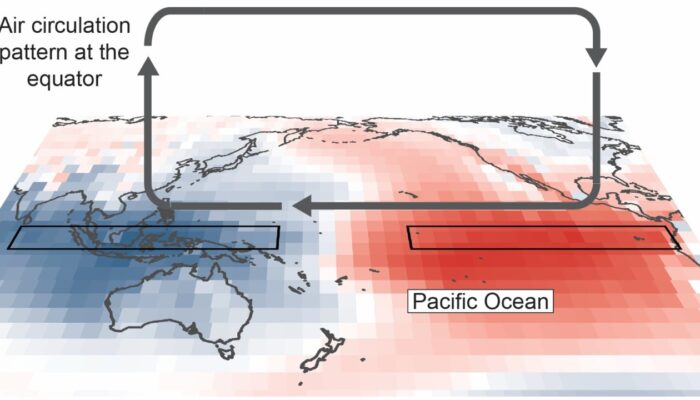
Above the ocean, the atmosphere responds through a circulation loop called the Walker Circulation. Air rises over the warm western Pacific, sinks farther east, and helps maintain the familiar trade wind pattern.
How the El Niño Weather Pattern Develops
During El Niño, the trade winds weaken. Warm water normally piled up in the western Pacific shifts eastward, suppressing the colder upwelling off South America. That shift affects marine ecosystems and fisheries, but it also changes the atmosphere above them.
Thunderstorms that typically develop near Indonesia begin migrating east into the central Pacific, following the warmer ocean temperatures. You can already see the warm patch emerging along the equator in early-May sea surface temperature (SST) anomalies.
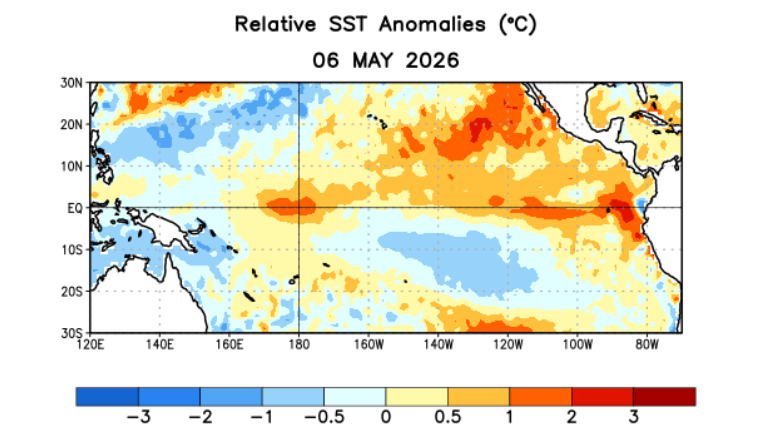
This is where the broader atmospheric response begins.
How El Niño Changes Global Weather
The displaced tropical thunderstorms matter because they alter atmospheric circulation far beyond the tropics. The process works like a chain reaction:
- Warm ocean water shifts east across the tropical Pacific
- Tropical convection follows the warmth as thunderstorms migrate eastward
- The Walker Circulation reorganizes, shifting rising and sinking air patterns
- Heating in the atmosphere launches Rossby waves that ripple outward
- Those waves reshape large-scale pressure patterns and the jet stream
The result is a reorganized atmospheric setup across the Pacific and North America.

In winter, the canonical signal often includes a stronger and more southward-shifted subtropical jet stream. That tends to favor wetter conditions across California and the southern United States, while parts of the northern tier often experience milder winters.
The El Niño weather pattern does not guarantee a specific outcome in every city, but it does tilt the odds toward recognizable seasonal trends.
Where the El Niño Weather Pattern Stands Right Now
Right now, the atmosphere and ocean appear to be moving toward El Niño conditions.
According to NOAA’s Climate Prediction Center, the ENSO Alert System remains at El Niño Watch. Weekly Niño 3.4 anomalies have climbed above +0.9°C, while subsurface temperatures have remained elevated for several consecutive months. Forecast probabilities continue increasing into late 2026 and peak during winter, when El Niño impacts are typically strongest.
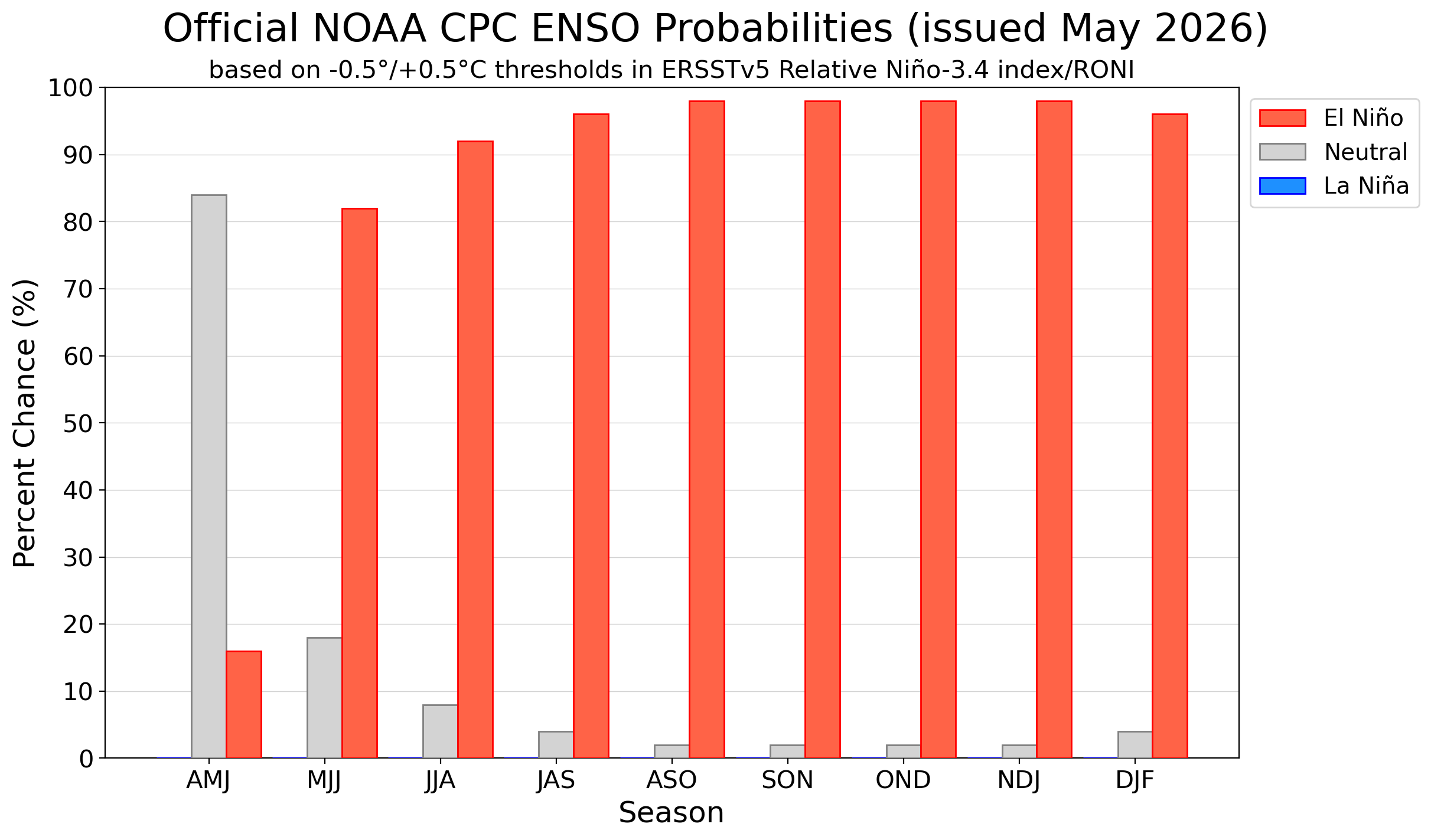
The question is increasingly becoming not whether El Niño develops, but how strong it becomes and how quickly the atmosphere responds.
What to Watch Through the Rest of the Year
The earliest impacts often emerge during summer and fall. In the tropics, El Niño can suppress Atlantic hurricane activity, disrupt monsoon patterns across parts of Asia, and contribute to drought in Indonesia and northern Australia. As autumn progresses, the atmospheric signal typically strengthens and becomes easier to identify in large-scale circulation patterns.
Winter is when the strongest and most reliable effects usually appear across North America. Seasonal forecast skill improves because low-frequency signals, such as ENSO, rise above the normal day-to-day weather noise.
While no outcome is guaranteed, changes in temperature and precipitation across the United States are often predictable enough to help emergency managers, businesses, and communities prepare.
Watching the El Niño Weather Pattern Emerge
At Wet Dog Weather, we spend a lot of time helping people visualize how weather signals evolve in real time. That is one reason understanding the El Niño weather pattern matters. The same tropical Pacific changes discussed above eventually appear in operational datasets, including sea surface temperatures and near-surface air temperature fields.
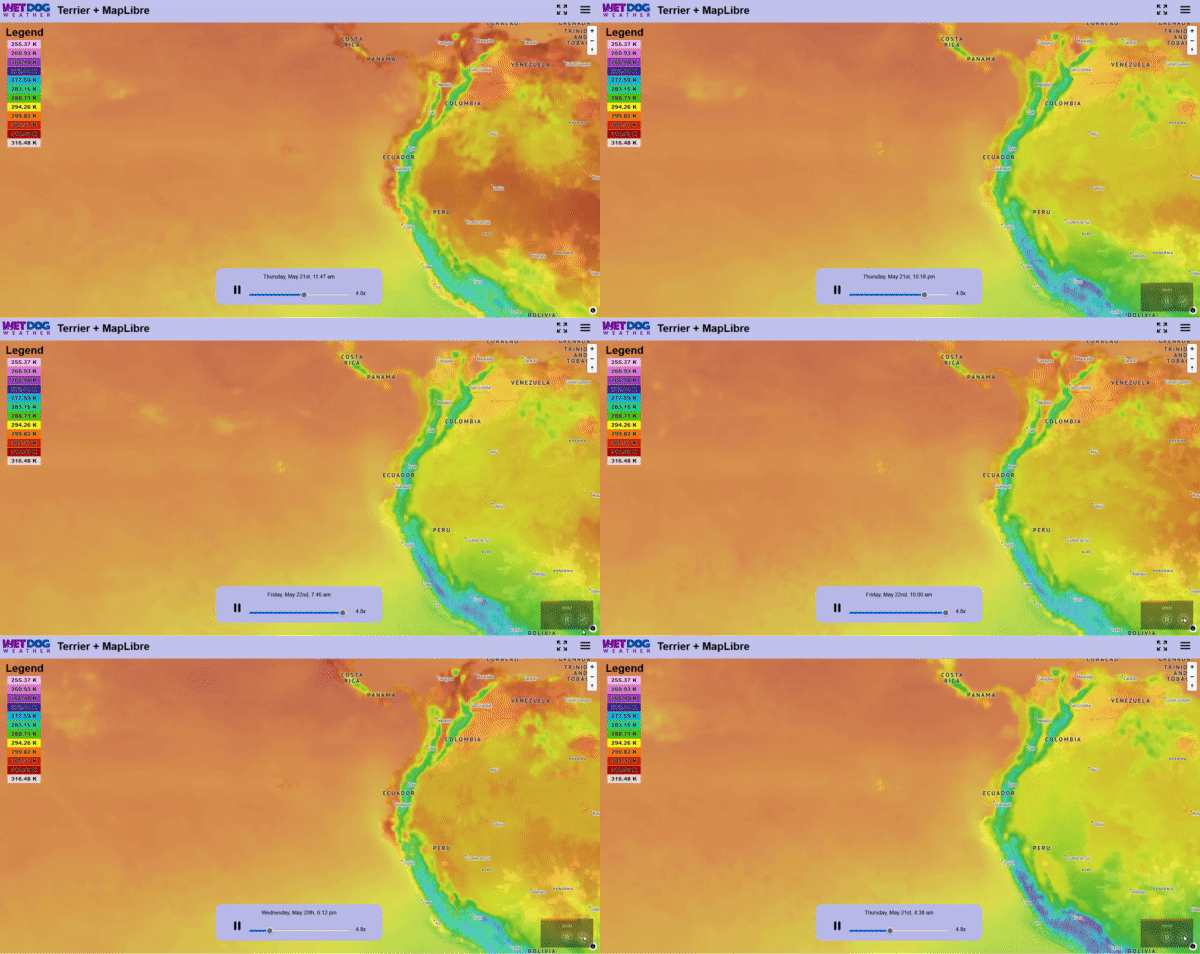
We do not issue seasonal outlooks, but we do provide operational weather data and visualization tools that make it easier to monitor the atmosphere as these larger climate signals begin to take shape. When a seasonal pattern starts emerging, seeing it develop is often just as valuable as hearing about it in a forecast.