We’re excited to announce a new product: Future Radar.
It’s our take on future radar data, showing where precipitation is headed, not just where it’s been.
The proper name for this is advected radar. The meteorological definition of advection is “transport of an atmospheric property by the wind.”
If you’re not a meteorologist, we’re basically moving radar forward in time using a “simple” optical flow algorithm.
What Does Future Radar Data Look Like?
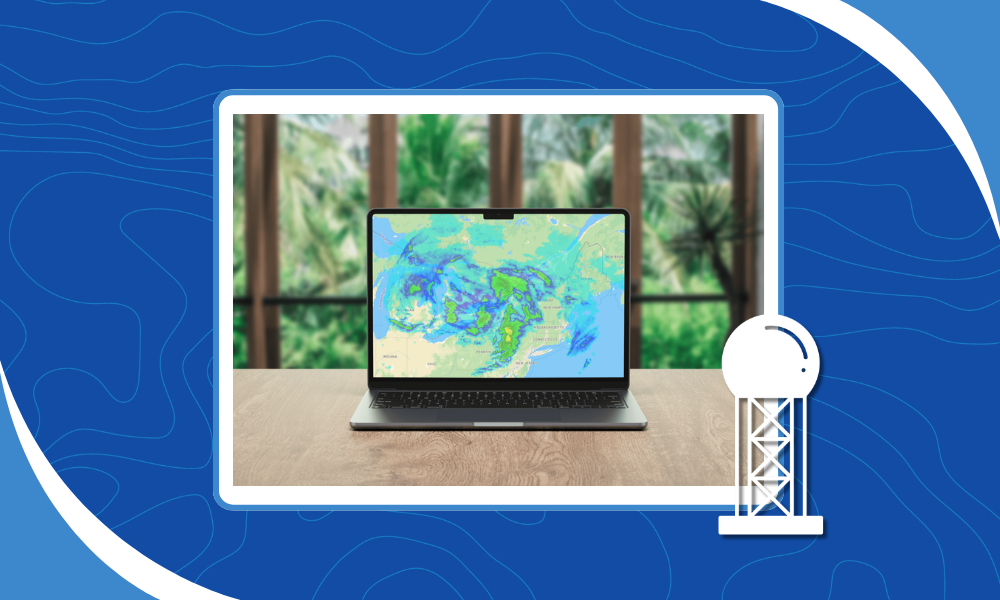
Future radar data looks like regular radar. You really need a video to see it properly.
This particular example is a recent storm in the Northeast. This loop is about 30 minutes out from the last measured radar frame. And it looks like radar… which makes sense.
For this sort of weather, it’s quite good, and the error is really low. For other types, it’s not quite as good. We’ll get our atmospheric scientist to explain it in a blog post soon.
What Is Future Radar Data Good For?
Future radar data is good for display, as above. Regular people have been looking at radar long enough to intuit which way it’s going and if they’re going to get rained on. You can show them an animation, and they can get the gist of it quickly. The future part just gives them a little more information to work with.
Automated systems don’t do so well with intuition. With a future radar data product, you can make the implied measurable. For instance, you can query a given spot to see if it’s going to rain in the next hour or so. You could send out an alert to individuals, cover your equipment, or turn off your watering system. The uses are endless.
Available Through our APIs
We’re offering future radar data (advected radar) to all our customers. It’s something we’ve always wanted to do, and a big thanks to the customer who got us going. Everybody can benefit.
You can find it in all of our products, but in very different ways.
For Terrier, it’s a new variable called “reflectivity_advected,” which is currently associated with the MCR product from the Multi-Radar Multi-System (MRMS) source. That’s the composite reflectivity from the MRMS provided by the NWS. We can provide an example of how to mesh it with measured radar for a nice, seamless display.
For Web Coverage Service, our data query product, the same applies. You’ll see it in the catalog, and it’s in the same units as reflectivity. The main difference is that it’s a proper forecast product, unlike the existing reflectivity, and it has a base forecast time and offsets like a normal forecast model.
For Labrador, it’s classified the same way. Once you filter down to an individual time slice, you can open a Zarr file directly and manipulate it. Why would you want to? Well, if you’re going to make thousands of queries, it’s more efficient to do them on the data rather than going through WCS.
For the GeoService, it’s in image tiles via WMTS and images via WMS. The structure is different because those Capabilities returns are different, but it’s easy enough to find. Just search for ‘advect’.
More Radar, More Data
Right now, we have future radar data available for CONUS, Hawaii, PR, and Alaska, as those are the regions the NWS provides. We have other radar importers in the works, waiting on customers. So if you’d like Europe, or Australia, or anywhere else we can get, we’d be happy to add it and hook it up to the advection.
In terms of variables, we’re just advecting composite reflectivity at the moment, but base reflectivity works well, as does ‘reflectivity at lowest altitude’. Just let us know if you’d like something different.
If you’re already working with radar, future radar data is a simple way to make it more useful, whether you’re building visualizations or triggering real-time decisions.